
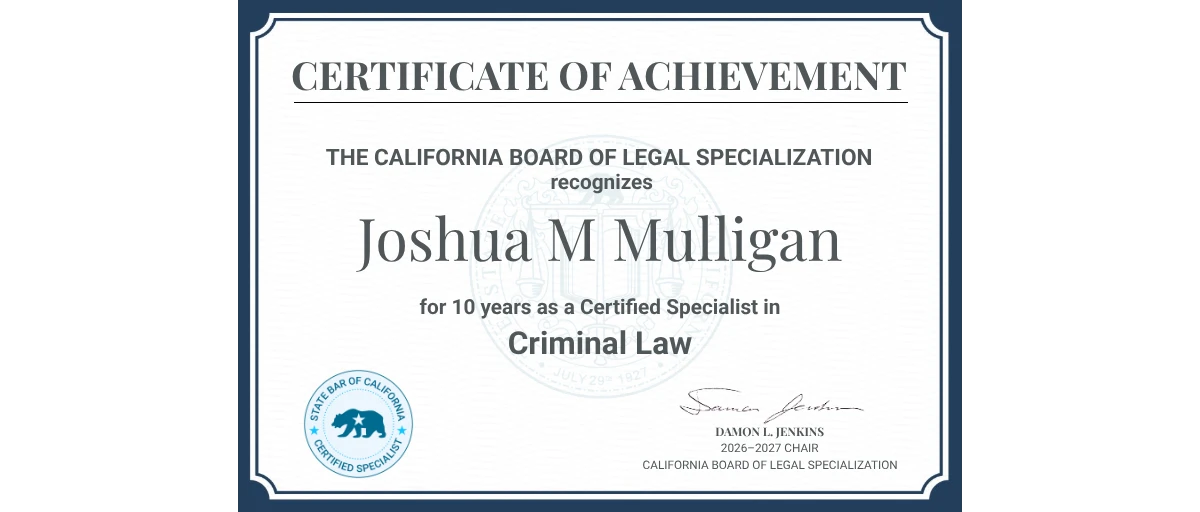
Ten years ago the State Bar of California made me a Certified Specialist, Criminal Law, The State Bar of California Board of Legal Specialization. This month it sent me a certificate marking the anniversary. That's a lot of words for one frame. Lawyers love a long title the way some people love a long receipt: proof that something expensive happened.
So let me tell you what happened, and why it should matter to anybody sitting in a courthouse hallway in Indio wondering what comes next.
California doesn't let a lawyer call themselves a specialist because they bought a nicer suit. First you sit for a six-hour written exam in criminal law, built a lot like the bar exam: essays and multiple choice, graded by lawyers who already hold the certification. Then you prove you've been lead counsel in at least ten jury trials and carried dozens more criminal cases through to the end. You take extra education in evidence, trial work and criminal procedure. Then the State Bar goes around asking judges, prosecutors and other defense lawyers what they think of you.
Think about that last part. Imagine your job review came from the people you spend all day arguing with. That's the deal.
Most lawyers never go through it. California has about 201,000 active lawyers, and the State Bar estimates fewer than 5,000 of them are certified specialists in any field. That's fewer than 3 in 100. Avvo, the lawyer directory, lists 8,949 California lawyers who handle criminal cases, many of them now and then, alongside a little of everything else. Statewide, only 248 active lawyers are certified in criminal law. That's about 2.8 percent of the lawyers Avvo lists for criminal work. Nobody's handing these out at the door.
And it doesn't last forever. You have to keep earning it: more trials, more education, more people asked to vouch for you. Ten years certified means I've stood for that inspection more than once, and I'd rather be inspected than assumed.
Spend a decade in criminal court and you learn the language. Nobody gets locked in a cage; they get “remanded into custody.” A person becomes “the defendant,” which is a fine word if your goal is to stop thinking of them as somebody's kid. A deal where one side holds nearly all the leverage is called a “bargain,” which tells you who's doing the shopping.
My favorite is “presumed innocent.” It's the most important idea in the whole system, and it usually lasts right up until the booking photo hits the internet.
I don't say this to be cute. Words are how a system gets ordinary people comfortable with things they'd never tolerate if they saw them plainly. Part of my job is to say things plainly.
Here's the arithmetic of a criminal case. On one side sits the government. It has police, crime labs, investigators, an office full of prosecutors and a name that makes it sound like the whole state is mad at you. On the other side sits one human being, usually scared, often broke, and a lawyer.
That lawyer is the only person in the room whose whole job is to be on that human being's side. Not the judge's side. Not the system's side. Theirs.
I started my career as a public defender, much of it at the Public Defender's Office in Indio. I learned there that a courtroom doesn't care how you feel. It cares whether you did the work: read every page of the report, found the witness nobody else called, knew the law cold, and stood up when it would have been easier to sit down. A jury can tell the difference between a lawyer who believes and a lawyer who's just billing. So can a prosecutor. So can a judge.
The certificate is what the State Bar said about that work. The work is what I owe the person standing next to me.
I've stood beside people on the worst day of their lives, and I've met very few people who were nothing but that day. A charge describes one moment, sometimes accurately and sometimes not. It isn't a biography. It doesn't mention the kid waiting at home, the job on the line, the illness nobody treated, or the twenty years of decent living that came before.
Our system is supposed to be equal. Too often it's equal the way a toll road is equal: open to everybody who can pay. People with money get time, experts and second opinions. People without it get speed. I didn't sign up to make the machine run faster. I signed up to make it slow down long enough to see the person in front of it.
Mercy isn't a weakness in a justice system. It's the part that proves there's justice in it at all.
Let me be straight, because that's the job. Being a certified specialist doesn't mean I can promise you a result. No honest lawyer can. Every case turns on its own facts, its own evidence and its own law. Anyone who guarantees you an outcome is selling you something, and it isn't legal representation.
What it does mean is that the State Bar looked hard at my trial work, my training and my reputation with judges and other lawyers, and decided to put its name next to mine. Twice now. After ten years, I'm still not tired of earning it.
If you or someone you love has been arrested or charged in Indio, Palm Springs, La Quinta or anywhere in the Coachella Valley, talk to a lawyer before you talk to anyone else. Call The Mulligan Defense at 760-777-4322 or reach us through mulligandefense.com. We'll listen first, tell you plainly where you stand, and get to work.
Figures are from the State Bar of California: active-lawyer count as of October 2026, and the Board of Legal Specialization's 2025 estimate of certified specialists. The criminal law specialist count is from the State Bar's attorney search as of October 30, 2026. The count of criminal lawyers is from Avvo's directory as of October 2026.
This post is for general information only and is not legal advice. Reading it does not create an attorney-client relationship. Every case is different, and past results do not guarantee a similar outcome.


