By attorney Joshua Mulligan. Mr. Mulligan has handled hundreds of Coachella and Stagecoach Music Festival Cases. These cases range from simple drug possession to more serious assault and rape cases. Mr. Mulligan is a State Bar Certified Criminal Law Specialist and his practice is in the Coachella Valley. Mr. Mulligan has an office in La Quinta, only a few miles from the Indio Polo Field.
We do not seek to encourage (or discourage) people from using substances at the Stagecoach and Coachella Festivals. Festival goers are often surprised by the strict enforcement at the festivals, given that drug use is extremely common and generally poorly enforced. If police catch you at the festival with drugs, you will be arrested.

• Yes — lots of undercover cops blend in, and you won’t be able to spot them.
Yes. There are a lot of cops from the California Department of Alcoholic Beverage Control. According to a 2025 press release, they had 30-35 agents present each weekend last year. The police are undercover and try to blend in with the crowd. That means that they will also be dressed like everyone who is attending the festival and act as if they are just a normal festival goer. Undercover officers may have shaggy beards or bikini tops. Undercover officers may be heavily tattooed. You will not be able to recognize who is an officer, so just be paranoid until you have taken your drugs. They could be anywhere, but to be clear enforcement is extremely sporadic. Each weekend many thousands of people do drugs, yet there are only about 100 drug arrests each weekend. Please take precautions so you are not one of the unlucky ones!
• Bottom line: You can’t reliably identify undercover police — act like they’re around.
Yes. Police are active on social media. Officers have created fake accounts and offered to buy drugs. Also, the police know what 🔌, 🎉, and ⛷️ mean. You won’t fool anyone.
• Bottom line: Social media messages can become evidence — don’t assume it’s private or “clever.”
• The most common way people are caught is pulling drugs out of their socks or underwear immediately after clearing security.
People get caught because an officer sees “suspicious activity” as a person walks through security at the festival entrance. Officers are looking to see if a person is nervous or appears to be concealing something or passing something. If they see a person do something suspicious, they will most likely pull them off to the side to interrogate and search that person. Women may be asked to shake their bra while going through security - if that is your hiding spot use tape!
Another common spot where undercover cops may be lurking is the locker area. People will often meet up there to retrieve and pass drugs. If a police officer sees you do anything suspicious, multiple officers will approach you and begin questioning you.
• Bottom line: Entrances and high-traffic areas are where people get targeted — don’t give them “suspicious activity” to point to.
• Yes — buy-bust stings happen, and “sharing” can still be treated like sales.
It is never a good idea to sell drugs to anyone in the crowd at Coachella. For example, if a good-looking woman wants some molly or a joint from you, don’t sell it to her because she might be an undercover cop. Although it is legal to give away marijuana, it is always best to keep your drugs to yourself. If anyone tries to give you a payment for drugs, you should never accept it.
The law considers even giving away drugs to be furnishing, and thus the same as sales—a felony offense (Health & Safety Code 11379).
• Bottom line: Don’t sell or distribute drugs — you will be charged with a felony.
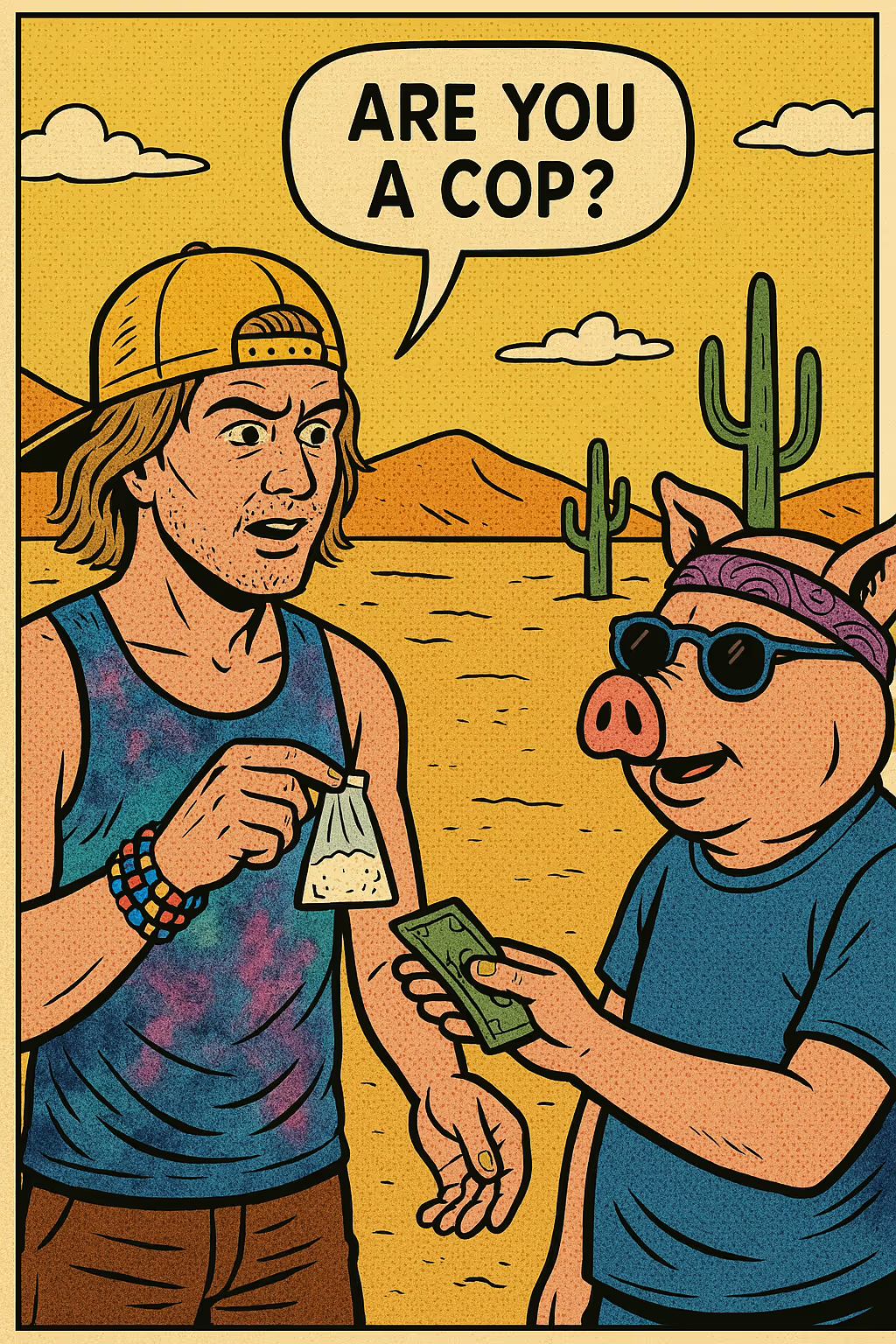
Look, somewhere between bad cop movies and barroom wisdom, America convinced itself that if you just ask an undercover officer "are you a cop?" they have to tell you the truth — like it's some kind of magic spell, a legal safe word that makes the whole system play fair. It doesn't. There is no law — not in any state, not in any federal statute, not carved into any courthouse wall — that requires police to identify themselves when asked. They can lie to your face, and they will, because that's the entire business model of undercover policing. The Supreme Court blessed the whole charade over half a century ago in Lewis v. United States, 385 U.S. 206 (1966), holding that an undercover agent who lies about who he is doesn't violate your constitutional rights. Read that again. The highest court in the land looked at government agents deceiving citizens and said, "Yeah, that's fine."
So where does the myth come from? It's a cocktail of Hollywood nonsense, a mangled understanding of entrapment law, and the very human desire to believe there's some rule that keeps the powerful honest — some question you can ask that forces the truth out of the machine. There isn't. Entrapment means the government has to make you do something you never would have done on your own — it doesn't mean a cop can't look you dead in the eye and lie about his badge. The system was never designed to play fair with you. It was designed to catch you. And if your entire legal strategy is asking "are you a cop?" you're not outsmarting anybody — you're just auditioning for a prison bunk with a folklore defense that's never gotten a single person acquitted in the history of American jurisprudence.
• Ask if you’re being detained. If no, walk away. If yes, stay silent and don’t consent to searches.
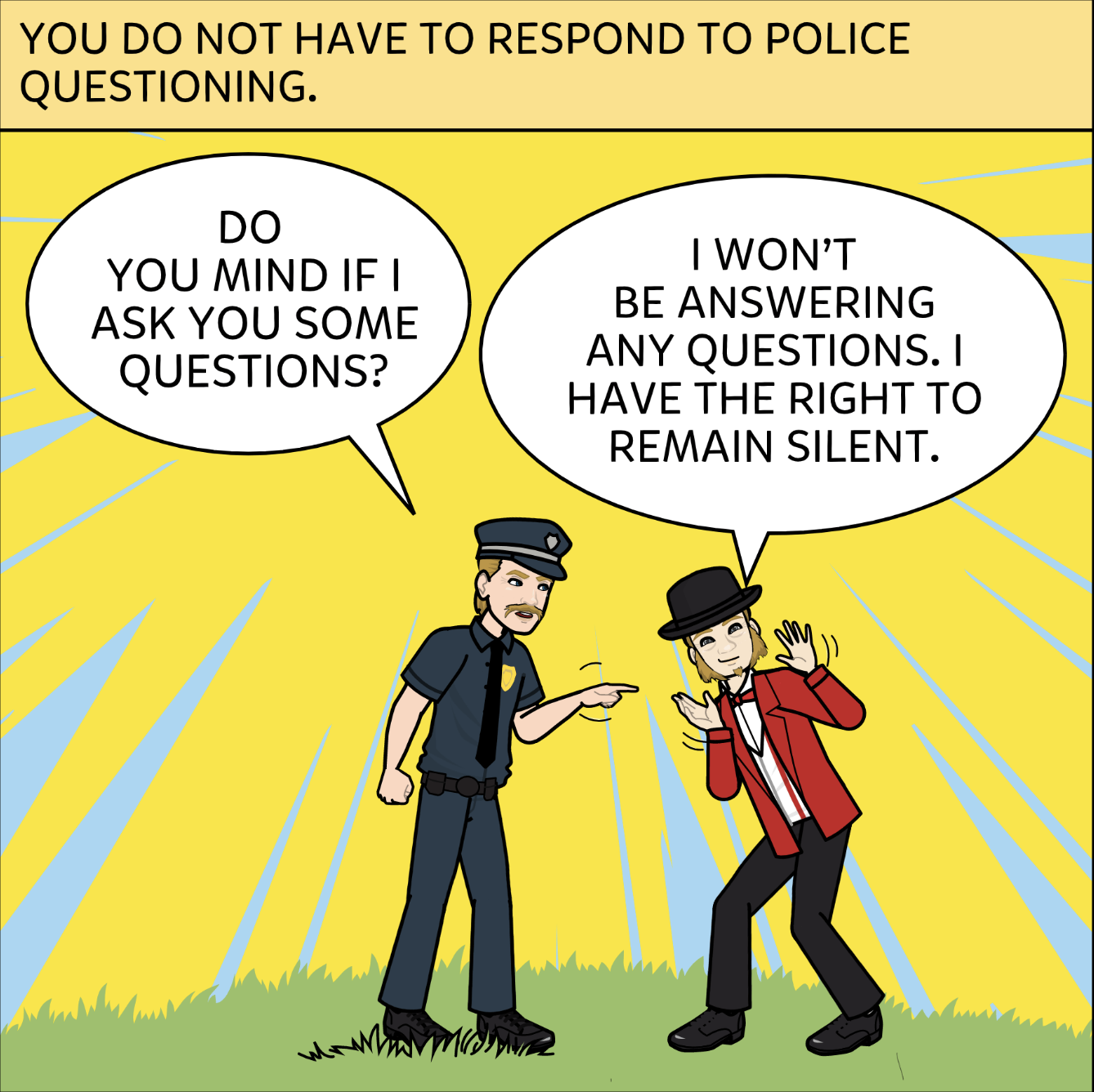
In addition to video recording (see below), remember you do not have any obligation to speak to the cops. If someone approaches you and they do not identify themselves as a police officer, just tell them to leave you alone. You have no obligation to speak to anyone. If a police officer approaches you and identifies himself or herself, the first thing you want to ask is if you are being detained. If the officer says no, you should walk away. If they say you are being detained, you should take the 5th and refuse to answer any questions - just tell the officers “I am asserting my right to remain silent.”
Speaking to the police is almost never a good idea. Your statement will be distorted and used to prove you guilty. You can’t talk your way out of an encounter like this, except by shutting up and refusing a “consensual” search.
Many people believe that confessing or “being honest” with police will result in leniency. In most situations, that is not how the system works. The Founders built the Fifth Amendment into the Constitution because they didn’t trust government interrogations. Their solution was simple: the government must prove its case — you don’t have to help.
Law enforcement officers are gathering evidence, not negotiating outcomes. Anything you say can be used to build a case against you, and officers typically do not have authority to promise reduced charges or leniency.
Even statements that seem minor — such as admitting the drugs were yours or explaining how you obtained them — can significantly strengthen the prosecution’s case.
If you are detained or arrested at a festival like Coachella, a safer approach is to remain calm and respectful while exercising your right to remain silent.
NO! If police ask to search your belongings, just say “NO!” Only allow a search if you have been commanded by an officer. Do NOT be scared to ask for specific clarification from an officer about the command. For example, you can say, “I do not consent to any search of my property. Are you commanding me to allow the search?”
It is best to get your refusal to search on audio or video recording, because if your objection to the search is weak or half-hearted, the officer’s report will most likely say something like, “I asked the subject if I could search his pockets and backpack. The subject consented.”
Yes. The first thing you want to do in this kind of situation is record your encounter with the police. It is always best to have a friend of yours who witnesses the encounter record it. You should also record in order to ensure that you are able to capture everything that is being said during your encounter with the cops - turn the video recorder on but don’t point it at police. If you are by yourself then it is even more important that you pull out your phone and start recording. As of 2024, Alcoholic Beverage Control undercover officers at the festivals were still not using any sort of recording device to document arrests. Your recording of the arrest will be the only reliable record of your encounter with police.
You will be arrested and handcuffed, then transported by golf cart to “Festival Jail”, which is a tent where they take arrestees for processing. Never answer any of their questions, except your name and identifying information. Officers will photograph you and any drugs that they found on your person. Then they will give you a citation for a criminal case with a court date in the month of July or August. After all of this is done, you will be released back into the festival. The same thing applies for an alcohol arrest.
I hear this from people every year. This is simply not true. If you have a citation to appear (the ticket you were given after arrest), the DA won’t be sending any letter reminding you to come to court. If your case is filed and you do not attend court, the judge will issue a warrant for your arrest.
In the cases that I have seen over the past several years, I would estimate that more than 95% of the arrests at Coachella result in the filing of a criminal case. I have not seen any clear pattern in the cases that don’t make it to court. My theory is that most of those cases probably are not filed due to some kind of clerical error.
You can check on the filing status of a case by calling the Riverside County District Attorney in Indio, or by searching your own name on the Riverside County Superior Court website.
With these kinds of cases most people will enter diversion. If there is a defense such as unlawful search or lack of evidence, then you might want to consider hiring an attorney. If you are from out of state or from out of the country, there can be complications without an attorney as well. If you are someone who has a professional license, it is always recommended to use extra scrutiny to find some kind of defense. Another thing to consider is if you have to travel long ways it might be cost effective to hire an attorney - your attorney will appear at your court dates for you and you will not need to make the trip.
If you are not a US Citizen, you need to hire an attorney.
For people who live in southern California and confessed and consented to a search, I usually recommend that you go to court yourself and save the attorney fees. You are welcome to call my office and talk about your specific case to sort out if this is the best option for you.
No. However, it will show up on background checks.
You will not need to appear if you have retained an attorney to represent you in your case. If you have an attorney your attorney can submit the paperwork to begin diversion immediately, or set the case for another hearing so that you can review the police report for legal issues before agreeing to diversion terms.
If you do not have an attorney, the prosecutor will give you forms to sign to enter diversion. You will not be shown the police reports if you appear without an attorney.
If the drugs were for personal use, you may qualify for pretrial drug diversion under Penal Code 1000. You plead not guilty. You can't have a felony conviction, or a drug conviction other than a minor personal-use offense, in the five years before the arrest, and the judge decides whether to grant it. Finish the program and the case is dismissed, and the court can seal the arrest record. (Penal Code 1000(a); 1000.1(b); 1000.2(a); 1000.3(d); 1000.4(a).)
Indio judges also offer misdemeanor diversion under Penal Code 1001.95, often called judicial diversion. The law lets the judge offer it even over the prosecutor's objection, for up to 24 months. In local practice at the Larson Justice Center, judges have typically ordered 20 to 40 hours of community service, an 8-hour online drug class and a $100 fee, with dismissal after about 6 months. That's typical, not promised, and it's the judge's call in each case. It's usually offered only to people with no record and small amounts of drugs. (Penal Code 1001.95(a)–(c).)
Yes. Since 2025, most festival drug arrestees have been offered pre-filing diversion. They are sent a letter saying they can take a short online class, and the DA will not file charges at all once the class is complete.
If you are offered pre-filing diversion, you may not need to hire an attorney or make travel plans. You can wait until you verify whether your case is filed in court. Search the court records here.
The terms can vary a bit depending on the judge, but generally diversion has included 20-40 volunteer hours, an 8-hour online drug class, and a $100 fee. Those are typical local terms, not guaranteed.
You can do the volunteer hours at any non-profit. The group you work with just needs to complete a letter on letterhead verifying you completed the volunteer hours.
At the dismissal date your attorney may be able to appear for you without you traveling to Indio. This may depend on the judge and how difficult it might be for you to travel to Indio.
Since January 1, 2018, PC 1000 diversion requires no guilty plea. That matters because federal immigration law generally counts a case as a "conviction" only when there's a guilty finding, a guilty or no-contest plea, or an admission of facts, plus some punishment. (Assembly Bill 208 (2017); Penal Code 1000.1(b); 8 U.S.C. 1101(a)(48)(A).)
Judicial diversion is also done pre-plea, meaning that no guilty plea is ever entered prior to dismissal.
However, this does not mean you are in the clear for immigration purposes. You do not need to have a conviction to be deported or denied entry to the U.S. Immigration can also be problematic during the months that the case is pending. I always recommend that non-citizens consult with an immigration attorney and criminal defense attorney to review the specifics of their personal situation.



Joshua Mulligan is a State Bar Certified Criminal Law Specialist, a distinction held by fewer than 3% of California criminal defense attorneys. He’s a graduate of Cornell Law School, an Ivy League institution, as well as Trial Lawyers College which includes a four-week program of intensive study and practice in trial storytelling and effective advocacy.
Tell us your story today